
How to Build Sleep Routine That Holds
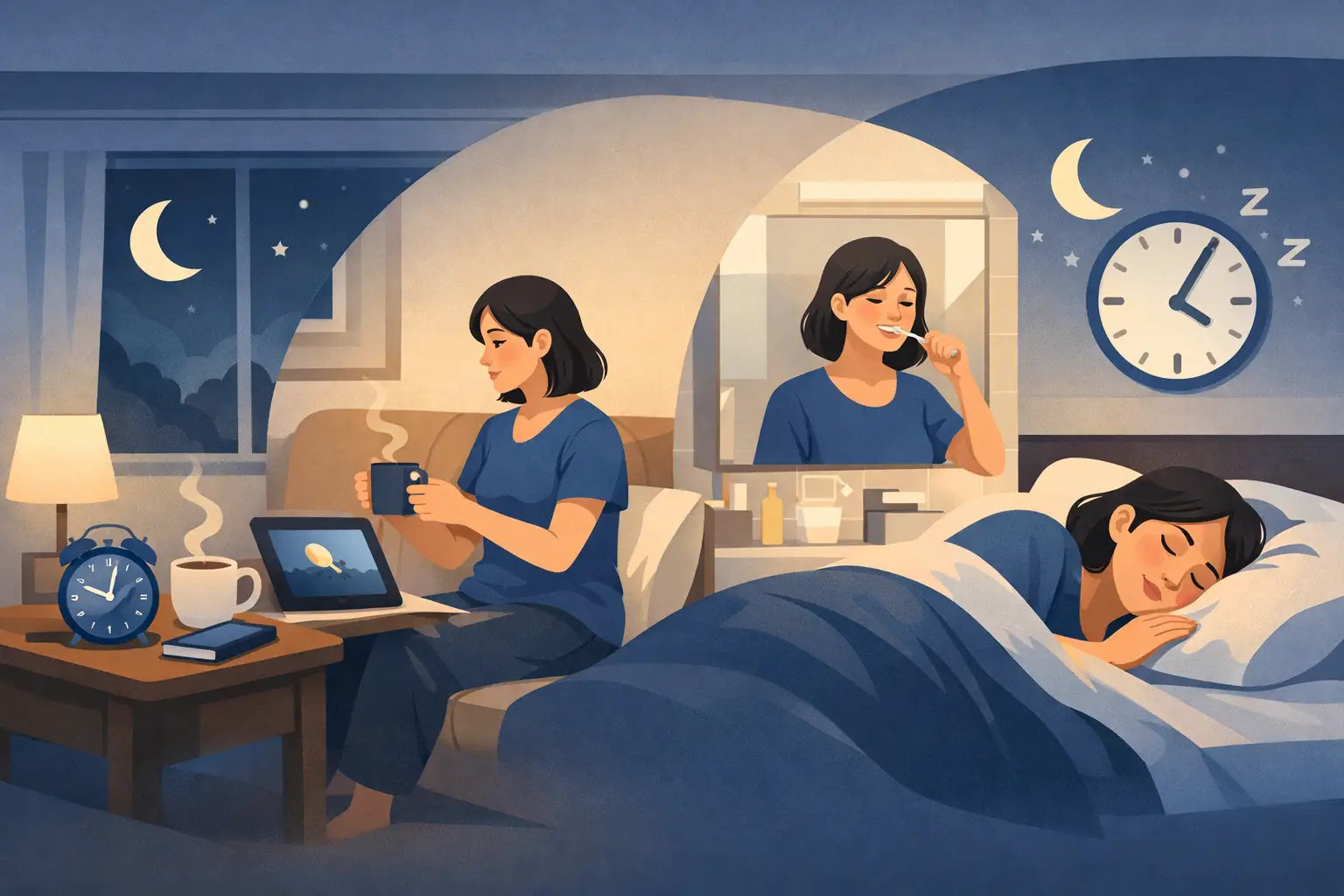
Most sleep advice fails for one simple reason: it asks for a perfect evening from people with imperfect days. If you want to know how to build sleep routine that actually lasts, start there. A durable routine is not built from discipline alone. It is built from repeated signals that tell the nervous system and circadian rhythm when to power down.
That distinction matters. Sleep is not a switch you flip at 10:30 p.m. It is the result of what your body has been tracking since morning - light exposure, caffeine timing, stress load, movement, meal timing, mental stimulation, and whether your system ever got a clear cue that the day was ending.
A useful sleep routine, then, is less about adding more rituals and more about reducing mixed signals.
How to build sleep routine from the morning forward
The most stable sleep routines begin long before bedtime. Your brain anchors sleep timing through circadian input, and morning light is one of the strongest signals in that process. Getting outside within the first hour of waking, even for 10 to 15 minutes, helps establish a clearer day-night pattern. If you wake before sunrise, bright light later in the morning still helps.
Wake time matters more than bedtime in the beginning. Many people try to fix sleep by forcing an earlier bedtime, then lie awake and conclude that nothing works. A more effective approach is to choose a realistic wake time and hold it steady for at least 10 to 14 days. Bedtime tends to organize itself more reliably once the morning anchor is consistent.
Caffeine deserves the same precision. For some people, afternoon coffee is inconsequential. For others, even a 2 p.m. cup quietly pushes sleep later and reduces sleep depth. If your routine feels fragile, move caffeine earlier before assuming you need a more complex solution.
The same is true for exercise. Movement generally improves sleep quality, but hard training too late can keep some nervous systems activated. It depends on the person, the intensity, and the training history. The point is not to avoid evening exercise categorically. It is to notice whether your body reads it as regulation or stimulation.
The evening problem is usually overstimulation
A modern evening often compresses the entire unresolved day into a two-hour window. Screens stay bright. Work continues informally. Meals happen late. Alcohol gets used as a sedative. Then sleep is expected to arrive on cue.
That sequence is common, but biologically messy. The body responds to pattern. If the last part of the day is unpredictable and stimulating, sleep onset becomes less reliable.
A good evening routine should do three things. It should lower cognitive load, reduce sensory intensity, and create a clear transition away from effort. That does not require a long checklist. In fact, the more elaborate the routine, the less likely it is to survive ordinary life.
Start with one hour before bed. Dim the environment. Lower the volume of what you are consuming, visually and mentally. Finish anything that feels administratively activating - emails, logistics, next-day planning - before that final hour if possible. If your mind tends to accelerate once you get into bed, a brief written brain dump can help because it moves open loops out of working memory.
Temperature also matters more than many people realize. Sleep onset is supported when core body temperature begins to drop. A cool bedroom helps. So does avoiding the kind of late-night friction that leaves you physically or mentally charged.
A sleep routine should be small enough to repeat
When people ask how to build sleep routine, they often expect an ideal schedule. What they usually need is a repeatable sequence.
A workable sequence might be as simple as this: finish food two to three hours before bed, dim lights an hour before bed, take a shower or wash up, set the phone away from reach, and go to bed at roughly the same time. That is enough to create pattern. You can build from there if needed.
The reason small routines work is that the brain learns by association. If the same cues show up in the same order night after night, they begin to predict sleep. If the cues change constantly, your system has less to rely on.
This is also why people often do better with subtraction than addition. Removing one destabilizing habit - late alcohol, doomscrolling in bed, 9 p.m. caffeine, erratic lights - may improve sleep more than buying five new sleep tools.
Where cannabinoids can fit
For some people, the hardest part of a sleep routine is not knowing what to do. It is getting the body to cooperate with the transition. A nervous system that remains alert late into the evening often needs more than intention. It needs a credible signal of safety and downshift.
This is where cannabinoids may have a useful role within a broader routine. Not as a substitute for circadian structure, but as support for it.
The endocannabinoid system helps regulate balance across stress signaling, mood, pain perception, and sleep-wake processes. When evening rest feels blocked by tension, physical discomfort, or persistent mental activation, a well-designed cannabinoid formula may help support the shift from daytime vigilance toward nighttime recovery.
That support is not one-dimensional. Different cannabinoid profiles may serve different sleep barriers. A CBD-forward formula may help settle the kind of cognitive overactivity that keeps the mind online. Formulations that include complementary cannabinoids and terpenes may provide a broader regulatory effect, especially when the issue is not just mental stimulation but whole-system tension. Timing matters here. Many people do better taking cannabinoids 30 to 60 minutes before bed rather than at the moment they want to be asleep.
Quality matters as much as timing. Sleep support is one area where formulation details become obvious in real use. Potency, cannabinoid spectrum, terpene composition, and consistency from batch to batch all shape outcome. A precise botanical formula is not interchangeable with a generic one, particularly when the goal is a repeatable physiological response.
Cannabinoids also work best when the rest of the sleep environment is coherent. If the lights are bright, the schedule is erratic, and stimulation runs right up to bedtime, no formula is likely to compensate fully. But when the routine is already sending clear signals, cannabinoids may help reinforce the transition.
What to do if your schedule is inconsistent
Not everyone can hold the same bedtime every night. Parents, shift workers, frequent travelers, and people with demanding schedules often need a more flexible model.
If that is you, protect the anchors rather than chasing perfection. Keep wake time as stable as possible on most days. Use a shorter pre-sleep sequence that can travel with you. Maintain the same order of events even if the clock time changes: dim lights, reduce stimulation, wash up, take your evening support, then bed. The sequence itself becomes the cue.
Travel introduces another variable - light. If your sleep routine collapses when you change environments, the issue may be less about your habits and more about the circadian confusion created by hotels, airports, indoor lighting, and late meals. In that context, returning quickly to morning daylight and a familiar pre-sleep sequence often does more than trying to force sleep.
Common mistakes that quietly undo progress
The first is changing too many variables at once. If you overhaul your evening, add supplements, stop caffeine, start magnesium, and try to sleep an hour earlier, you will not know what actually helped. Adjust one or two inputs and observe for a week.
The second is spending excessive time in bed awake. If your bed becomes the place where you think, plan, scroll, and grow frustrated, the association weakens. Bed should stay strongly linked to sleep.
The third is expecting instant results. Circadian rhythm responds to repetition, not urgency. If your current pattern has been inconsistent for months or years, it may take time for sleep pressure and timing to normalize.
Finally, many people confuse sedation with sleep support. They are not the same. A useful routine supports the body’s own sleep architecture rather than simply pushing through fatigue. That is one reason alcohol often backfires. It may compress sleep onset while degrading sleep quality later in the night.
Build the routine around the bottleneck
The most effective sleep routine is the one that addresses your actual obstacle. If your issue is a racing mind, focus on cognitive offloading and a calmer final hour. If it is physical tension, look at temperature, stretching, and whether a cannabinoid formula helps support muscular and nervous system downshift. If the issue is inconsistency, simplify until the routine is hard to miss.
Precision matters more than effort. A few signals, repeated in the right order, can change sleep more than an ambitious plan you abandon in three days.
Start with a stable wake time, a quieter final hour, and a sequence you can repeat without negotiation. If you use cannabinoids, use them intentionally - as part of the pattern, not apart from it. Good sleep rarely comes from force. It comes from giving the body clear reasons to let go.