
Organic Hemp Tincture for Mood That Makes Sense
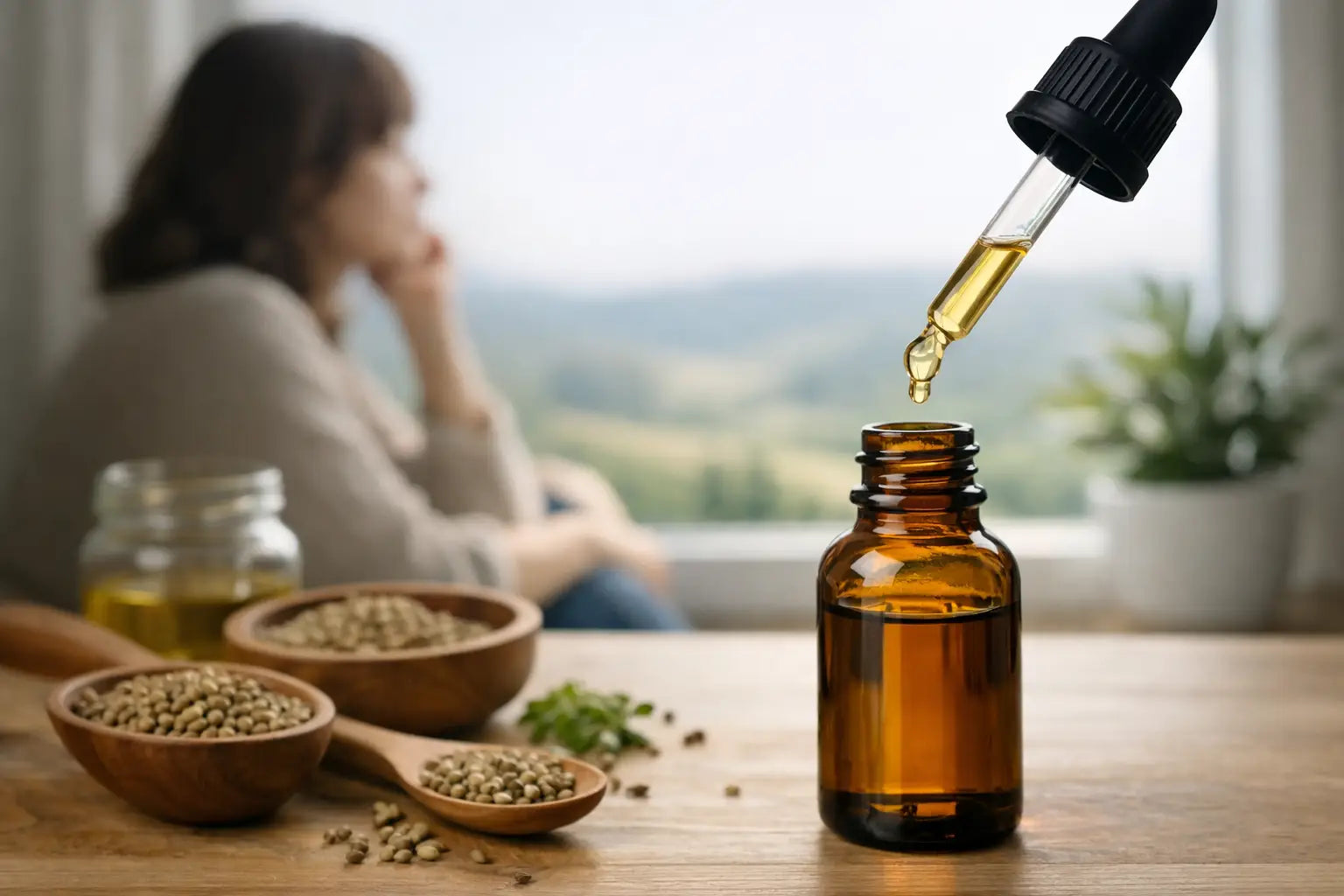
Mood rarely shifts for one reason.
A tense week, poor sleep, overstimulation, inconsistent meals, and too much time in front of a screen can all compress the nervous system at once. That is usually the real context for someone looking at an organic hemp tincture for mood. Not a dramatic problem. Just a body that is doing too much regulation with too little support.
That distinction matters, because mood support is often framed too narrowly. People are taught to look for a single active ingredient with a single expected effect. Hemp does not work that way when it is formulated well. Its value is not that it forces a certain feeling. Its value is that it can support the biological systems involved in steadiness, recovery, and adaptive response.
What an organic hemp tincture for mood is actually supporting
Mood is not just a psychological state. It is partly a regulatory outcome.
The endocannabinoid system helps modulate stress signaling, inflammatory tone, sleep-wake balance, and neural communication. When that system is under increased load, many people do not describe the problem as severe distress. They describe themselves as shorter, flatter, more reactive, less resilient, or less able to reset after pressure. That is where a well-formulated tincture can be relevant.
An organic hemp tincture for mood is best understood as a daily support for endocannabinoid tone rather than a fast emotional override. The goal is not sedation or stimulation. The goal is a more stable baseline - one with less friction and better adaptability.
That is also why results vary. If someone is under-slept, underfed, and overloaded, a tincture may help create more room in the system, but it will not cancel the underlying inputs. On the other hand, when used consistently alongside decent sleep, movement, and nutritional stability, cannabinoids can become part of a more durable regulatory foundation.
Why organic matters more than most labels suggest
In hemp, organic is not just a branding preference.
Hemp is a bioaccumulator, which means it can absorb compounds from the soil with unusual efficiency. That can be useful in agriculture, but in supplementation it raises the standard for sourcing. If the plant is intended for concentrated extracts, the quality of cultivation becomes part of the quality of the final formula.
Certified organic cultivation reduces exposure to synthetic pesticides and herbicides, but the more practical reason to care is integrity. A cleaner input gives a better starting point for extraction, formulation, and repeatability. For a discerning consumer, that is not an abstract value. It is part of whether a tincture feels considered enough to use daily.
Organic also tends to align with a broader production philosophy: controlled sourcing, smaller batches, tighter ingredient selection, and fewer formulation shortcuts. None of that guarantees effectiveness on its own, but it usually improves the odds that the product was made with system-level intent rather than market-level convenience.
The cannabinoid profile matters more than the headline ingredient
Many mood formulas are reduced to CBD content alone. That is an oversimplification.
CBD can play an important role in supporting calm and regulatory balance, but it is only one part of the picture. Depending on the formula, CBG, CBC, CBDA, CBDV, and terpene components may meaningfully shape the experience. Some cannabinoid profiles feel more settling. Others feel clearer and more centering. A strong formula is built around that profile logic, not just total milligrams.
This is where formulation quality becomes visible. A tincture intended for mood support should not feel conceptually vague. It should have a reason for its composition.
For example, a broad or full-spectrum extract may offer a more dimensional result than a single isolated cannabinoid because the compounds interact across overlapping pathways. That does not mean more ingredients are always better. It means the profile should be coherent. If the formula is designed to support emotional steadiness during the day, it should not push heavily toward heaviness or mental dulling. If it is meant for evening decompression, the balance may reasonably lean more grounding.
At Organic Green Roots, this is the difference between a commodity tincture and a purpose-built cannabinoid supplement. The interesting question is not whether a product contains hemp. It is whether the cannabinoid profile was designed to support a specific regulatory outcome.
How to assess a tincture without relying on marketing language
The language around mood support is often imprecise. Calm, balance, uplift, peace, stress support - these terms can be useful, but they are not enough.
A better way to evaluate a tincture is to look at a few formulation signals. Start with the extract type. Is it broad-spectrum, full-spectrum, or isolate-based? Then look at potency. Low-potency products can be useful for highly sensitive individuals, but many are simply underdosed for consistent daily effect. After that, consider whether the formula identifies supporting cannabinoids or terpenes, rather than hiding behind a generic hemp extract label.
Carrier oil also matters more than people assume. A clean, stable oil affects absorption, texture, and tolerance. Flavoring matters too, though less for efficacy than compliance. If a tincture tastes harsh or chemically masked, people use it less consistently, and consistency is where mood support tends to become measurable.
Testing is another useful filter. Third-party testing does not tell you everything, but it should confirm cannabinoid content and screen for common contaminants. For a product intended for regular use, that baseline is non-negotiable.
What using an organic hemp tincture for mood can realistically feel like
The best outcomes are often subtle at first.
People expect a clear event, then miss the more relevant signal: fewer sharp edges across the day. You may notice that you recover faster from interruption, carry less tension into the evening, or feel less internally crowded by ordinary demands. For some, the effect shows up as better patience. For others, it is a cleaner transition from work intensity into rest.
That subtlety is not a weakness. It is often a sign that the product is supporting regulation rather than overpowering it.
There is also a timing question. Some people feel a difference within an hour, especially with sublingual use, but mood support is usually better judged over one to three weeks of consistent use. Acute effects can matter, yet baseline effects matter more. The real test is whether your daily rhythm feels more manageable over time.
If it does not, that does not automatically mean the category failed. It may mean the dose is too low, the formula does not match the use case, or the expectation is misaligned. Daytime steadiness and evening downshifting are related, but they are not identical needs.
How to use it well
Start lower than you think you need, then give the formula enough time to reveal its pattern.
A modest, consistent dose taken at the same time each day is usually more informative than irregular larger doses. For daytime mood support, morning or early afternoon often makes sense. For those whose mood destabilizes as stress accumulates later in the day, a split dose can work better. The exact amount depends on body size, sensitivity, cannabinoid experience, and the formula itself.
Hold the tincture under the tongue briefly before swallowing if the product is designed for sublingual use. This can improve onset for some users, though not dramatically in every case. More important is tracking how the product fits into your actual day. If it makes you feel too quiet, the formula may be better suited to evening. If it feels too light, potency or cannabinoid composition may need to change.
The useful mindset is observational, not aspirational. You are not trying to feel transformed. You are assessing whether the product improves your ability to stay regulated in ordinary life.
When mood support requires a more precise formula
Not every tincture labeled for calm is truly built for mood.
Some formulas are too general, some are too weak, and some are designed around marketing categories rather than physiology. If your goal is emotional steadiness without cognitive drag, precision matters. A thoughtful tincture should reflect intended function in its cannabinoid profile, extract quality, organic sourcing, and dosing logic.
That level of specificity is especially relevant for people who are sensitive to overstimulation but still need to stay sharp. It is also useful for those who are not looking for a temporary sense of relief, but for better day-to-day resilience under normal modern pressure.
A good organic hemp tincture for mood should feel less like an intervention and more like infrastructure. Not dramatic. Not vague. Just one well-made part of a more regulated system.
If a tincture earns a place in your routine, it will probably do so quietly - by making your internal environment easier to work with, one ordinary day at a time.