
Topical vs Tincture for Pain: Which Fits?
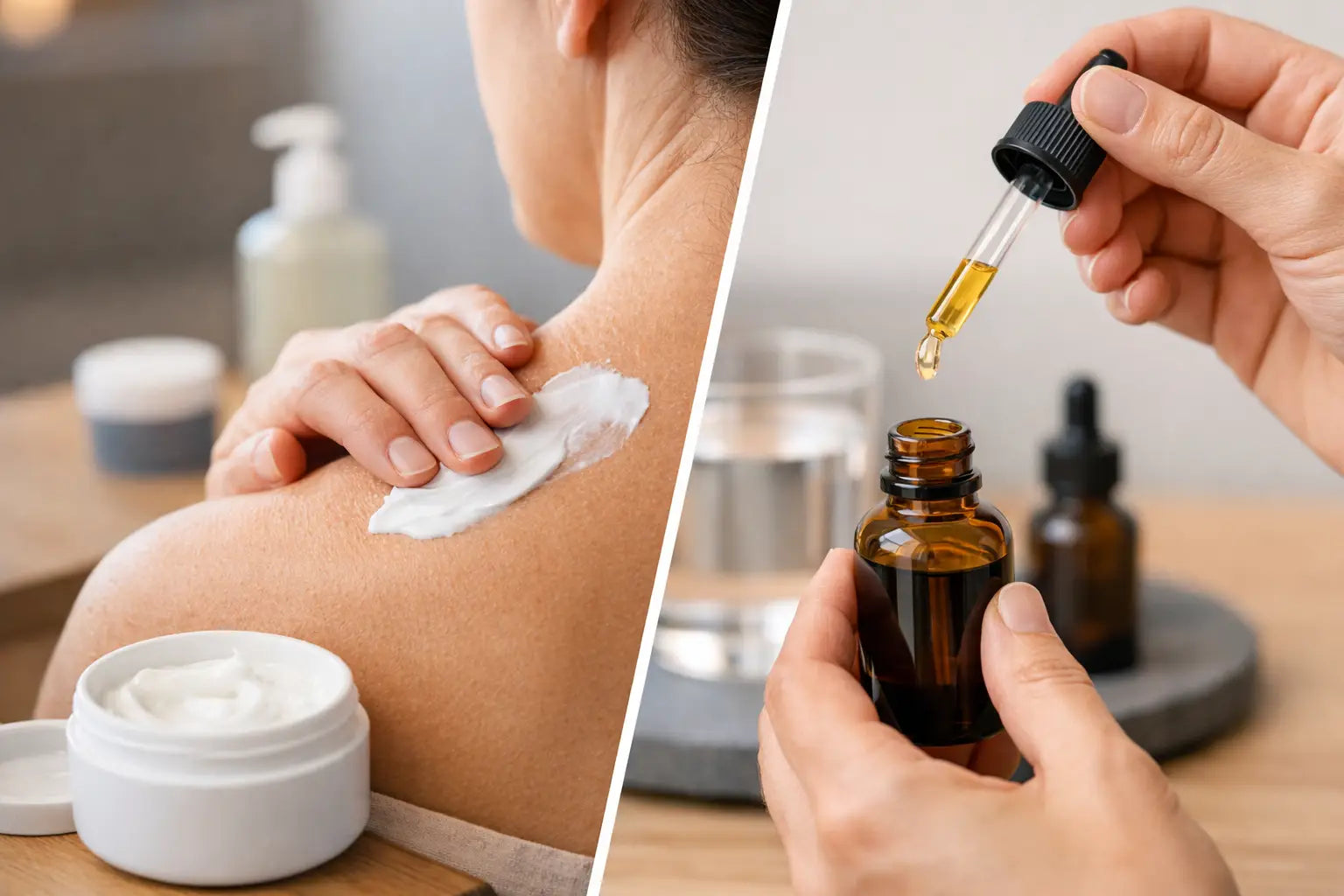
When pain shows up in the same place every day - a tight shoulder, irritated hands, a knee that complains after stairs - the format matters as much as the cannabinoid itself. That is the real question behind topical vs tincture for pain. Not which is better in the abstract, but which route of delivery matches the kind of support your body is asking for.
Cannabinoids are active plant compounds, and delivery changes the outcome. A topical works at the level of local tissue. A tincture moves through the digestive and circulatory route and has the potential to influence broader endocannabinoid tone. Both can be useful. They simply solve different problems.
Topical vs tincture for pain starts with location
If discomfort is easy to point to with one finger, a topical is often the more precise choice. Balms, creams, and transdermal-style formulas are applied directly where the body feels overloaded. That matters because the skin is not just a barrier. It is a biologically active interface rich with signaling activity, and cannabinoid receptors are part of that local landscape.
A well-formulated topical may support comfort in muscles, joints, and connective tissue close to the surface. It can also be useful when the goal is targeted support without involving the whole system. For someone who wants to address post-exercise soreness in the calves or recurring tension in the neck, topical delivery is often the cleanest match.
A tincture is different. It is not aimed at one spot. It is better suited to discomfort that feels diffuse, recurrent, or tied to the nervous system rather than a single irritated area. If pain tends to move, linger, or arrive with poor sleep, stress load, or physical depletion, an internal format may make more sense because it supports regulatory balance more broadly.
This is why the question is less topical versus tincture as competitors and more topical versus tincture as tools. One is local. One is systemic. The distinction sounds simple, but it changes the experience considerably.
How a topical works
Topicals deliver cannabinoids to the skin and nearby tissues. Depending on the formulation, they may also include botanicals such as arnica, menthol, camphor, or essential oil fractions that create additional sensory effects. Those ingredients can shape how quickly a product feels active, but the cannabinoid profile still matters.
CBD is often used for its broad balancing role. CBG may be included in formulas intended for physical tension and body stress. CBC is increasingly interesting in topical design because of its interaction profile and relevance to skin-level signaling. Full-spectrum or broad-spectrum extracts may also bring terpenes and minor cannabinoids that deepen the formula rather than reducing it to one isolated compound.
The advantage of a topical is precision. You can apply it where needed, reapply when appropriate, and often feel whether the formula is useful within a relatively short window. It is practical for hands, wrists, shoulders, knees, feet, and the lower back. It also appeals to people who do not want cannabinoids as part of their daily internal routine.
Its limitation is equally clear. A topical cannot do much for discomfort that feels generalized or rooted in broader stress physiology. If the issue involves body-wide tension, poor recovery, or a nervous system that never fully downshifts, local application may help one area while missing the larger pattern.
How a tincture works
Tinctures are designed for internal use, typically held under the tongue before swallowing. That route gives cannabinoids access to the bloodstream more efficiently than standard edibles and allows a more measured dose than many other formats. For people who value consistency, tinctures are one of the more controllable options.
In the context of pain support, a tincture may be useful when discomfort is persistent, widespread, or linked to overall endocannabinoid imbalance. The endocannabinoid system helps regulate pain signaling, inflammatory tone, stress response, and sleep architecture. When those systems are under strain, a tincture may support the terrain that pain is moving through rather than only the place where pain is felt.
That distinction matters. Pain is not always a local event. Sometimes the shoulder hurts because training load is high and recovery is poor. Sometimes the back feels worse after several nights of light sleep. Sometimes the body becomes more reactive under sustained stress. In those situations, systemic cannabinoid support can be the more intelligent starting point.
Tinctures also allow more deliberate formulation. A product may emphasize CBD for steady baseline support, include CBG for daytime function, or bring in minor cannabinoids and terpenes to shape a broader effect profile. This is where formulation science earns its place. Cannabinoids are not interchangeable, and a thoughtful tincture is built around a specific outcome.
The trade-off is timing and feel. A tincture usually requires more patience than a topical, and the result may be subtler at first because it is not creating a direct sensation at the exact point of discomfort. For some users, that broader support becomes more valuable over time. For others, especially those with clearly localized soreness, it can feel less immediately relevant.
Topical vs tincture for pain in real life
If you wake up with stiff hands, apply support to one knee after long walks, or hold tension in the same shoulder every afternoon, a topical is often the obvious first move. It is direct, contained, and easy to match to the body map of the issue.
If your discomfort tends to fluctuate with stress, affects multiple areas, or becomes more noticeable at night, a tincture may offer better leverage. It supports the regulatory systems that influence how pain is perceived and processed, not just the tissue that feels irritated.
There is also a middle category that often gets overlooked: layered use. Many people do best with both. A tincture can help establish steadier baseline support, while a topical is kept for predictable flare points such as the neck, lower back, or joints after activity. This is not redundancy. It is route-specific formulation.
That layered approach reflects how the body actually works. Local tissue signaling and whole-body regulation are not separate worlds. They interact. A smart cannabinoid routine can do the same.
What to look for in either format
Quality matters more than category. A weak or poorly designed tincture will not outperform a thoughtful topical, and the reverse is just as true. The useful question is whether the formula shows intent.
With topicals, look for meaningful cannabinoid content, not decorative dosing. The base should also make sense. A balm or cream needs carrier ingredients that hold cannabinoids against the skin and support absorption. Texture, spread, and staying power are not cosmetic details. They affect performance.
With tinctures, potency should align with regular use, and the cannabinoid profile should be transparent. Hemp extract, carrier oil quality, and whether the formula includes complementary cannabinoids all matter. A sophisticated tincture is built for consistency, not novelty.
This is also where product integrity separates serious cannabinoid companies from generic wellness brands. Extraction quality, small-batch control, and formulation discipline directly shape the result. Organic Green Roots approaches cannabinoids this way - as precision botanical tools designed around function, not trend.
Choosing the right format for your pattern
The cleanest way to decide is to ask three questions. Where is the discomfort? When does it show up? And does it feel isolated or systemic?
If it is isolated and predictable, start with a topical. If it is broad, recurrent, or connected to sleep, stress, or recovery, start with a tincture. If both descriptions fit, that usually means both formats have a role.
There is no prize for choosing one category permanently. Bodies change. Training cycles change. Work stress changes. The right cannabinoid format is the one that fits the current pattern with the least friction and the most precision.
Pain support works better when the delivery method respects the biology. Sometimes that means meeting the body exactly where it hurts. Sometimes it means supporting the regulatory system beneath the signal.