Best Hemp Products for Sleep, Explained
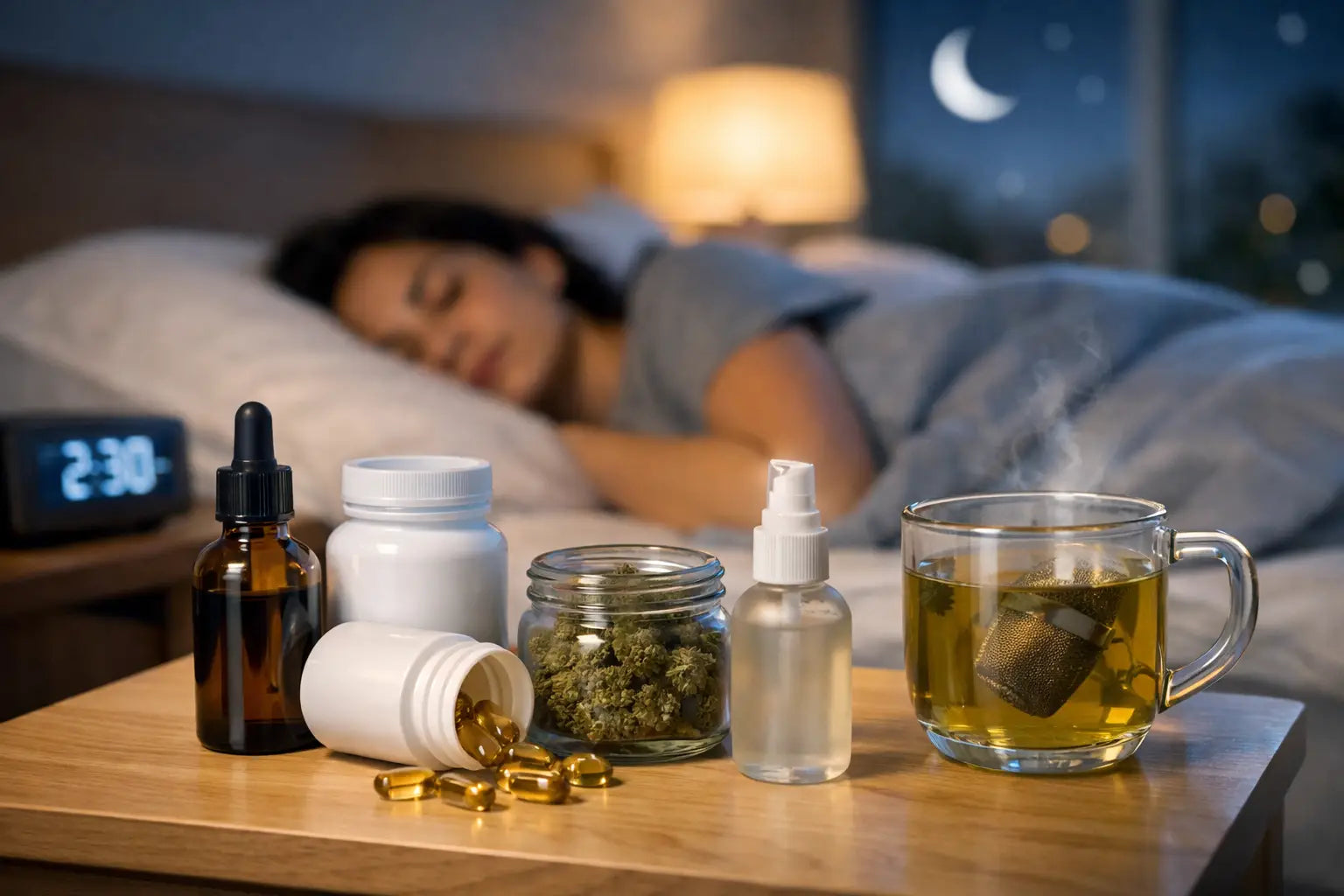
A bottle labeled for sleep tells you very little. The real question is whether the formula is built to support nighttime regulation - not just whether it contains hemp. The best hemp products for sleep tend to share a few traits: a thoughtful cannabinoid profile, a delivery format that fits your routine, and a formulation that respects how sleep actually works.
Sleep is not one event. It is a sequence of regulatory shifts involving nervous system tone, cortisol rhythm, muscular tension, mental activation, and the body’s ability to settle into recovery. That is why hemp can be useful here. Cannabinoids interact with the endocannabinoid system, a broad signaling network involved in balance, stress response, and homeostatic regulation. When a hemp product is formulated well, the goal is not to force sedation. It is to support the conditions that allow sleep to happen more reliably.
What makes the best hemp products for sleep different
The strongest sleep formulas are rarely the simplest. A generic CBD product may help some people, especially if occasional mental overactivity is the main issue, but sleep support usually benefits from more than a single isolated cannabinoid. Full-spectrum and broad-spectrum hemp extracts often offer a more complete effect because they include multiple cannabinoids and, in some cases, native terpenes that contribute to how the formula feels.
This matters because sleep disruption has different drivers. Some people need support downshifting from a long workday. Others need help reducing physical tension at night. Others are not especially stressed, but their sleep rhythm is shallow or inconsistent. A more complete hemp formula can address these patterns with greater nuance than a single-ingredient product.
Quality also separates serious sleep products from average ones. Hemp is highly sensitive to extraction method, source material, and formulation stability. If potency is vague, cannabinoid content is minimal, or the ingredient list reads like a generic supplement with a trace of hemp added for marketing, it is probably not a meaningful sleep formula.
The best hemp product types for sleep
Full-spectrum tinctures
For many adults, a full-spectrum tincture is the most adaptable option. Tinctures allow precise dose adjustment, which matters because the right amount varies more than many people expect. They also absorb relatively quickly compared with capsules, making them useful when you want support within a predictable evening window.
A good nighttime tincture often combines CBD with smaller amounts of complementary cannabinoids such as CBN, CBG, or CBC, depending on the formulation philosophy. CBD is often the structural backbone, supporting calm and broader endocannabinoid tone. CBN is commonly used in nighttime products because many formulators find it helpful in evening blends. CBG can be useful in lower amounts when a formula is designed to support stress regulation without feeling flat or heavy. CBC is less common, but in a broad profile it may contribute to overall effect.
The advantage of tinctures is control. If your sleep needs change with travel, training load, or a demanding work period, a tincture lets you respond without changing products entirely.
Gummies for sleep support
Gummies are often dismissed as entry-level, but that is not always fair. A well-made hemp gummy can be an excellent sleep format, especially for people who want consistency and ease. The main trade-off is speed and flexibility. Gummies take longer to come on because they move through digestion, and you cannot fine-tune the dose as precisely as with a dropper.
Still, the best hemp products for sleep in gummy form can work very well when the formula is intentional. Look for meaningful cannabinoid content per serving, not token amounts. Added botanicals can also make sense here, though they should complement the hemp extract rather than distract from it. Ingredients like lemon balm, L-theanine, or magnesium may fit a nighttime formula when used with restraint.
What matters most is whether the gummy is engineered as a real delivery system, not a confection with a wellness label. Texture and flavor are secondary to cannabinoid profile, dose integrity, and batch consistency.
Softgels and capsules
Softgels are useful for people who value routine. They offer the cleanest dosing experience and often fit well into an existing evening supplement protocol. For someone who wants the same amount every night and prefers not to taste hemp extracts, this can be the best format.
The limitation is timing. Capsules usually take longer to take effect, and that delay can be either helpful or inconvenient depending on your schedule. If your evenings are structured, this is manageable. If your bedtime shifts often, a tincture may be easier to work with.
Softgels also tend to suit people who are using hemp not as an occasional sleep aid, but as part of a broader effort to support recovery, stress resilience, and more stable nighttime regulation over time.
High-potency blends
Some people do not need a different product type. They need a more serious formula. If you have tried low-dose CBD products and felt very little, the issue may not be hemp itself. It may be inadequate potency or an incomplete cannabinoid profile.
High-potency products can be useful when nighttime dysregulation is tied to accumulated stress load, physical wear, or a persistently elevated baseline. More is not automatically better, but underdosed hemp products are common. A product with enough cannabinoid material to create a measurable effect is often more relevant than one with a long list of trendy ingredients.
How to choose the right hemp sleep formula
Start with the pattern, not the product category. If you have trouble settling mentally, a full-spectrum tincture or gummy with CBD and calming co-factors may be a good fit. If your issue is more physical tension and a wired-but-tired state, a broader cannabinoid profile may matter more than added sleep herbs. If you want stability and repetition, softgels make sense.
It is also worth paying attention to spectrum type. Full-spectrum formulas preserve more of the plant’s native complexity, including trace cannabinoids and terpenes, and many people find that these formulas feel more complete. Broad-spectrum products can still be effective, especially for those who prefer THC-free options, but the overall profile should still be substantial and clearly defined.
Read the label closely. You want to know the total cannabinoids per serving, the specific cannabinoids included, whether the extract is full-spectrum or broad-spectrum, and what else is in the formula. Vague language like proprietary blend or hemp extract without cannabinoid detail is not especially useful.
Formulation details that actually matter
Carrier oil is one of them. MCT oil is common for good reason - it is stable, efficient, and supports cannabinoid absorption. Hemp seed oil can make sense too, though it is nutritionally distinct from cannabinoid-rich hemp extract and should not be confused with it.
Terpenes are another factor. They should not be treated as decorative. In a sleep formula, terpene choices may shape the overall profile in meaningful ways. A carefully preserved extract with its native aromatic compounds intact often feels more sophisticated than a stripped-down distillate with sleep branding added later.
Then there is dose architecture. Some formulas are built around a strong CBD base with supporting cannabinoids in smaller amounts. Others emphasize CBN or combine cannabinoids with botanicals. Neither approach is inherently superior. It depends on whether the formula has internal logic and whether that logic matches the user’s actual sleep pattern.
How to use hemp products for sleep more effectively
Timing matters almost as much as formulation. Tinctures often work best when taken 30 to 60 minutes before bed. Gummies and softgels may need more lead time, often closer to 60 to 90 minutes. The point is not to take them at bedtime and hope for immediate results. Give the formula time to interact with your system.
Consistency also helps. Hemp tends to work best when used with some regularity, especially when the goal is better nighttime regulation rather than a one-off sedative effect. That does not mean you must use it every night forever. It means a thoughtful trial over several evenings usually tells you more than a single use.
And if a product does not work, avoid assuming hemp is ineffective. The issue may be format, potency, timing, or formulation profile. Sleep is too complex for a one-variable interpretation.
Best hemp products for sleep are built, not branded
The market is crowded with products that borrow the language of rest without much formulation substance behind them. The best products are usually quieter. They tell you what cannabinoids are present, how much you are getting, how the extract is built, and why the formula belongs in the evening.
That is the standard worth using. Not whether a package looks calming, but whether the product reflects real formulation discipline. Organic Green Roots approaches cannabinoids from that more exacting perspective - as plant compounds with regulatory relevance, not generic wellness ingredients.
A good sleep formula should feel considered before you ever open it. If the cannabinoid profile is clear, the dose is meaningful, and the format fits your actual routine, you are already much closer to a product that can support a better night.